
These past few years, rapid advances in artificial intelligence (AI) have come with a running commentary about what will change. Depending on who you ask, AI is either the next internet-level shift or a very expensive experiment. In this blog, we will be focusing on how AI is changing the way many people approach social media, especially for small businesses and lean marketing teams under pressure to do more with less.
AI promises speed, lower costs, and fewer barriers to creating content. Adoption is also accelerating rapidly, with Globalization Partners’ (G-P) ‘AI at Work 2025 Report’ stating that 91% of global executives are already embedding AI into a significant portion of their workflows. For social media, it promises quicker copy, easier ideation, less friction and content creation that’s suddenly available to everyone.
Despite this surge of interest and integration, we’re still in the early phase of working out what is and isn’t a good usage case for all these AI programmes and features. AI has come for us all at hurtling speed, power, and the capacity to navigate huge complexity across all sorts of applications in a matter of seconds. Even if AI doesn’t live up to the stratospheric levels of hype set by investors and enthusiasts, it seems set to stay as a significant presence in most people’s professional lives. So, what does ‘good’ look like? Why are so many brands still struggling to turn all that apparent efficiency into content that people genuinely want to engage with?
This is what we will be exploring in this three-part blog series on AI and social media.
Part One: How AI is Changing Social Media Marketing for Small Businesses (you are here).
Part Two: What’s Wrong With AI-Generated Social Media Content?
Part Three: Tips For Using AI for Social Media Marketing.
Why AI Appeals to Social Media Marketers
Those who have most fervently bought into generative AI for social media often mention a democratised creative process. This means, with AI chatbots and assistants, anyone can very quickly use AI to generate text, audio, images, or videos for whatever purpose they can think of. Now, anyone can produce grammatically sound, tonally clean and SEO-optimised hooks for almost any subject matter in seconds. And much of this is available for free.
At first blush, the capability of Gemini, Copilot, and other tools is remarkable. For example, you can request a whole social media calendar for a year of social content for your brand, including copy, creatives, and alt text.
This sounds exactly like the paradigm shift for work that AI evangelists are priming us for. To the believer, AI has reduced the essential pillars of social media content and strategy (short-form copywriting skills, graphic design, video editing, SEO knowledge, etc.) to a toe-height hurdle. In its most fully realised state, it could save several hours of labour and expenses for one-person self-promo rodeos, teams of suit-and-tie managers, and heavyweight PR agencies alike.
So, let’s try it!
For this example, let’s say I’m running social media for a very small cybersecurity company, and I want to make a LinkedIn post promoting the importance of staying safe online. First, I use Copilot 365 and enter the prompt: ‘make a social media post geared to LinkedIn about the importance of online safety and where I can learn more’.
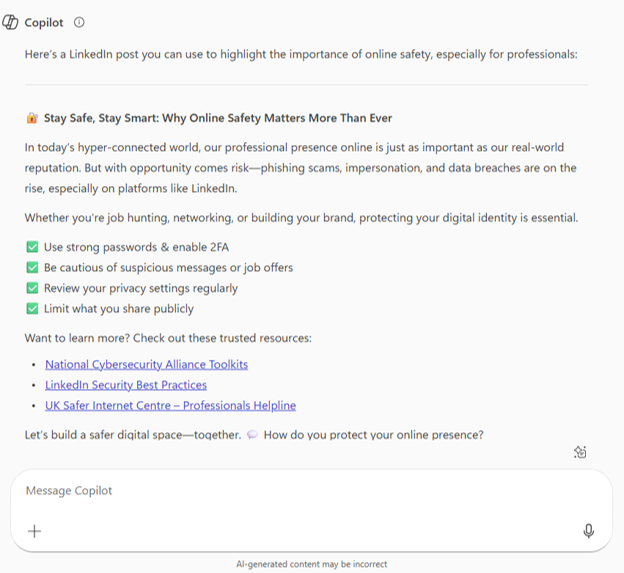
We have a nice headline, four check box bullet points, three working links to find out more, and a call to engagement at the end. This is solid, but a nice eye-catching graphic to go with the post would be even better.
Time to hand it over to AI again. I switch over to Google’s Gemini model, which is better with image generation, to make me a graphic. I prompt: ‘Illustration of a professional LinkedIn profile on one side and a shadowy hacker figure on the other, separated by a digital shield icon symbolising online protection’.

While it’s clearly missed the mark with ‘Litxhedin’ rather than LinkedIn, this is a decent result! Doubly so considering Gemini is a generalist, free-to-use generative AI that isn’t optimised for social media creative. Smaller tasks like hashtag generation and alt text were also handily taken care of, all without a paid subscription service.
Obviously, it’s not perfect. The weird mush of letters that is ‘Litxhedin’ serves as a reminder that AI’s copy generation capabilities are often better than its image generation. AI can consistently provide a grammatically sound and serviceable post with a graphic. In many cases, most people scrolling their feed wouldn’t even notice the typo. And, with some time investment, you can get results much better than this cybersecurity example.
The results themselves are going to keep improving too. The now-common sentiment in AI circles is ‘this very moment is the worst that AI tools will be for the rest of your life’. The quality, ease of use and capability of AI feels inevitable, as long as enormous tech-sector investment keeps pouring in. It’s not hard to see how this looks like golden ticket stuff, especially for a solo entrepreneur strapped for money and time who are looking for fast creative assets to promote their products and services. AI can also be invaluable as a writing assistant for non-native English speakers, those not confident in their writing ability, or people with disabilities or additional needs that makes writing and other content creation more challenging.
That’s the promise of AI for social media: speed, accessibility and a much lower barrier to producing content that looks passable at first glance. But, if it’s this powerful, why is so much AI content still failing on social media?
We will explore this in part two of this AI and Social Media series. See you next time!
Max Britton has been part of the Smith Goodfellow team since early 2025 as our Digital & Social Media Executive. You can follow him on LinkedIn or discuss any of the content in these blogs with us on our social channels: Instagram, LinkedIn, Facebook, and Threads.