Why does a lot of AI-generated content fall flat on social media? The issue isn’t that AI can’t produce content. It clearly can. The issue is that the more people who use it without any form of quality control, the more social feeds fill up with work that sounds polished and looks serviceable but says almost nothing. Below we will explore some of the common issues that come from solely relying on AI outputs without sufficient human oversight and a clearly defined process.
The AI ‘House Style’
AI-generated content often has recognisable patterns. In writing, the clearest tells include em dashes, heavy emoji use, overly polished grammar, American English by default, and a formulaic, punchy rhythm that sounds neat but generic. It also tends to lean on stock phrases and tidy aphorisms (aka short, wise sayings) that feel written to sound clever rather than say anything original.
As frustrating as it is for those who used em dashes ( — ) frequently pre-2022, if you want to minimise comparisons to AI house style you may want to move away from them. Try substituting the em dash with its shorter cousin, the en dash ( – ), or two hyphens (–).
Fun fact: the former is my preferred method, and the latter is Mark Zuckerberg’s preferred means of using an em dash without actually using an em dash!
AI-generated visuals have their own giveaways too: warped or misspelt text, odd hands or anatomy, strange lighting and shadows, inconsistent perspective, and smudged or overly painterly details. In video, mismatched sound and lip movement can be another clue. You’ll also often see AI used to create exaggerated, emotionally manipulative scenes designed purely to drive engagement.
The real brand risk
Most critically, AI is increasingly being associated with high-output, low-quality content. Recognisably AI-generated content on social media, in particular, is increasingly blamed for a degenerated experience on social platforms – Facebook and X especially.
You may have heard the term AI slop – a term coined to describe low quality, artificially generated, often bizarre online content. This is usually made quickly to engineer intense emotional responses (e.g. compassion, fear, outrage, etc.). You can see an example below: an AI-generated image of a fake child with a cake and sign made to farm as much engagement as possible from unsuspecting social media users, usually for profit.

As part of its report on social media conversations, Visibrain conducted sentiment analysis in December 2025 which indicated that 28.9% of AI slop mentions were negative. AI Slop is the main perpetrator of what feels like a distinctly worse-quality experience on social media today. Updates from friends and local communities, in many cases, have been subsumed by AI images and video, and no major platform has yet found a way to curtail the influx of low-quality, engagement-bait AI writing and media.
Because AI is a prime suspect in the deterioration of virtual spaces, there is growing distaste for any AI usage at all, with varying degrees of discomfort depending on demographic and industry. For example, Forbes reported on a Nielsen study that revealed 55% of audiences surveyed were uncomfortable with AI in media, especially for articles and stories, as they felt there was a higher risk of bias and misinformation.
Regardless of where you work, careless AI usage can seriously damage the credibility of your social media presence and the quality of your brand. And even if you use AI responsibly, you still risk an association with slop. This is why, if you use AI, it’s essential to stay abreast of your market’s attitude towards identifiably AI content. It is also important to communicate your position effectively, have a formalised AI policy for internal teams to understand the risks and responsibilities, in addition to encouraging open communication about any concerns inside and outside your organisation where appropriate.
The Iterable Customer Engagement Report 2026 states:
“Consumers aren’t rejecting the machine. They’re scoring it. AI is now a defining factor in brand trust, not because it exists, but because of how it handles data and decisions.
Consumers don’t distrust AI-driven engagement. They distrust brands that use it carelessly. Get it wrong, and you don’t just lose attention. You get permanently filtered out.”
The debates about AI’s impact on trust, transparency, and authenticity are ongoing and this is certainly the case for its use for social media marketing. Whether you’re a solo trader or part of a marketing team in a global business, you have likely used a social media management platform. Many of them now have incorporated AI tools which I’ve found range from fairly useful to terrible. For the former, Sprout Social’s AI-powered alt text tool is quite handy for quickly generating reasonably accurate alt text to accompany your images. On the other end of usefulness, Hootsuite’s AI post generator is built into the social media calendar to allow you to make quick commemorations of national holidays and other events, which initially sounds like a marketer’s dream!
So, let’s take it for a test drive. For the below example, Hootsuite generated this post for Margarita Day on the 22ndFebruary:
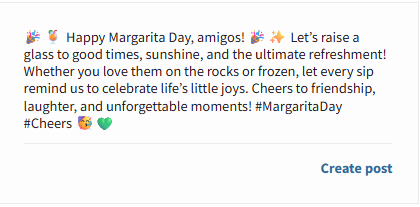
Without significant revisions, this post is unfocussed, non-strategic, hollowly sentimental, and completely forgettable. AI-made posts like the above follow AI house style hallmarks to a stunningly generic effect. Your post will instantly be lost in the noise of the feed. And, if you’re paying extra for these AI features, seriously consider whether they’re worth it. Social media management suites can already feel expensive, especially for a small business.
If fully AI-generated content isn’t the answer, the more useful question becomes: where should brands use these tools and where should they hold back?
In the next blog in this AI and Social Media series, we will present a practical guide to how and where AI can save you time, how to reduce the risks to your brand’s reputation, and how to maintain a human voice in your marketing.
If you would like to explore the other blogs in this series, you will find the links to them below:
Part One: How AI is Changing Social Media Marketing for Small Businesses.
Part Two: What’s Wrong With AI-Generated Social Media Content? (you are here)
Part Three: Tips For Using AI for Social Media Marketing.
Max Britton has been part of the Smith Goodfellow team since early 2025 as our Digital & Social Media Executive. You can follow him on LinkedIn or discuss any of the content in these blogs with us on our social channels: Instagram, LinkedIn, Facebook, and Threads.